With so many options available, it’s completely normal to feel overwhelmed when choosing a childcare centre, especially as first-time parents. And while there’s no single “best” early learning centre, the best facility is the one that meets your child’s needs and aligns with your family’s values so you feel confident and supported.
Some desktop research is a great starting point, but the only way to really grasp the quality of a childcare centre is to book a tour and visit the facility in person. If you’re unsure how to choose the right childcare centre, we’ve created a practical checklist to help you know exactly what to look for during a centre tour.
1. Qualified Early Childhood Teachers leading the program
Early Childhood Teachers (ECTs) are university-qualified, having completed specialised training in early childhood development, learning, and school preparation. In Queensland, government-approved Free Kindy programs must be delivered by a qualified ECT, who is often supported by a team of diploma-qualified educators.
Having an ECT at the helm supports stronger learning outcomes by helping children develop socially, emotionally, and cognitively. Oversight from an ECT ensures that childcare programs are intentional and encompass a thoughtfully designed curriculum that prepares children for a successful transition to school.
A question worth asking: How many qualified early childhood teachers are on the team?
2. A strong National Quality Standard (NQS) rating
Overseen by The Australian Children’s Education & Care Quality Authority (ACECQA), the National Quality Standard (NQS) provides a benchmark for early childhood education and care services across Australia. It encompasses seven quality areas identified as important outcomes for children.
Childcare services are assessed and rated against each quality area, and then given an overall rating based on their performance. Ratings include:
- Excellent: Services that receive ACECQA’s Excellent rating are celebrated for their outstanding education and care, leadership within the early childhood sector, and dedication to ongoing growth and improvement.
- Exceeding: The service achieves standards beyond the National Quality Standard in at least four of the seven quality areas.
- Meeting: The service fosters quality learning, development, and care across all seven quality areas.
- Working towards: The service offers a safe education and care program and is focused on improving specific areas to enhance children’s learning and wellbeing.
The NQS provides an independent assessment of quality across several key areas, including educational programs, staffing, health and safety, relationships, and governance.
A question worth asking: What improvements have been made since the assessment?
3. Warm, genuine educator and child relationships
A key aspect of the NQS is ensuring educators build warm, responsive relationships that help children feel safe, secure, and that they belong. With such importance placed on educator-child bonds, it’s essential to look beyond the facilities and observe high-quality interactions between educators and children during your tour of the centre.
Children learn best when they feel secure and connected to those around them. Positive relationships between educators and children are essential for building confidence and emotional wellbeing.
What to look for: Notice whether staff get down to children’s level during their interactions.
4. Settled, consistent educators, and low staff turnover
A stable team of long-term educators is a sign of a happy workplace and a positive childcare environment.
A consistent team of teachers and educators help children feel safe and allows them to develop strong, lasting relationships over time. Low staff turnover also means less disruption to routines and learning.
A question worth asking: How long have the teachers and educators worked at the centre?
5. A real curriculum, not just activities
Quality early learning centres deliver play-based, interest-led learning programs that support children’s development and lifelong learning. In Queensland, approved services follow the Early Years Learning Framework (EYLF) and Queensland Kindergarten Learning Guideline (QKLG) to ensure children from birth to five receive consistent, high-quality education that prepares them for a successful transition to Prep and beyond.
Early learning approaches should be intentional and responsive. Educational activities should connect to children’s interests and developmental goals. For example, our curriculum at KIDS ELC is inspired by the Reggio Emilia philosophy of early childhood learning, so our early learning program has a strong focus on creativity, exploration, and collaboration.
A question worth asking: How do children’s interests influence the curriculum?
6. Thoughtfully designed learning spaces
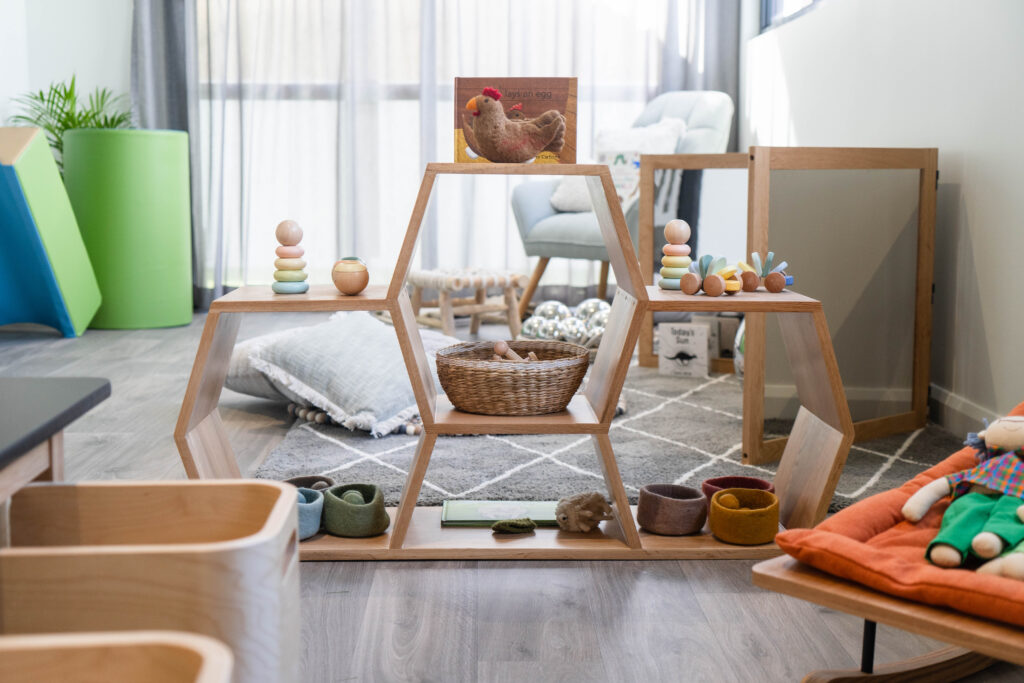
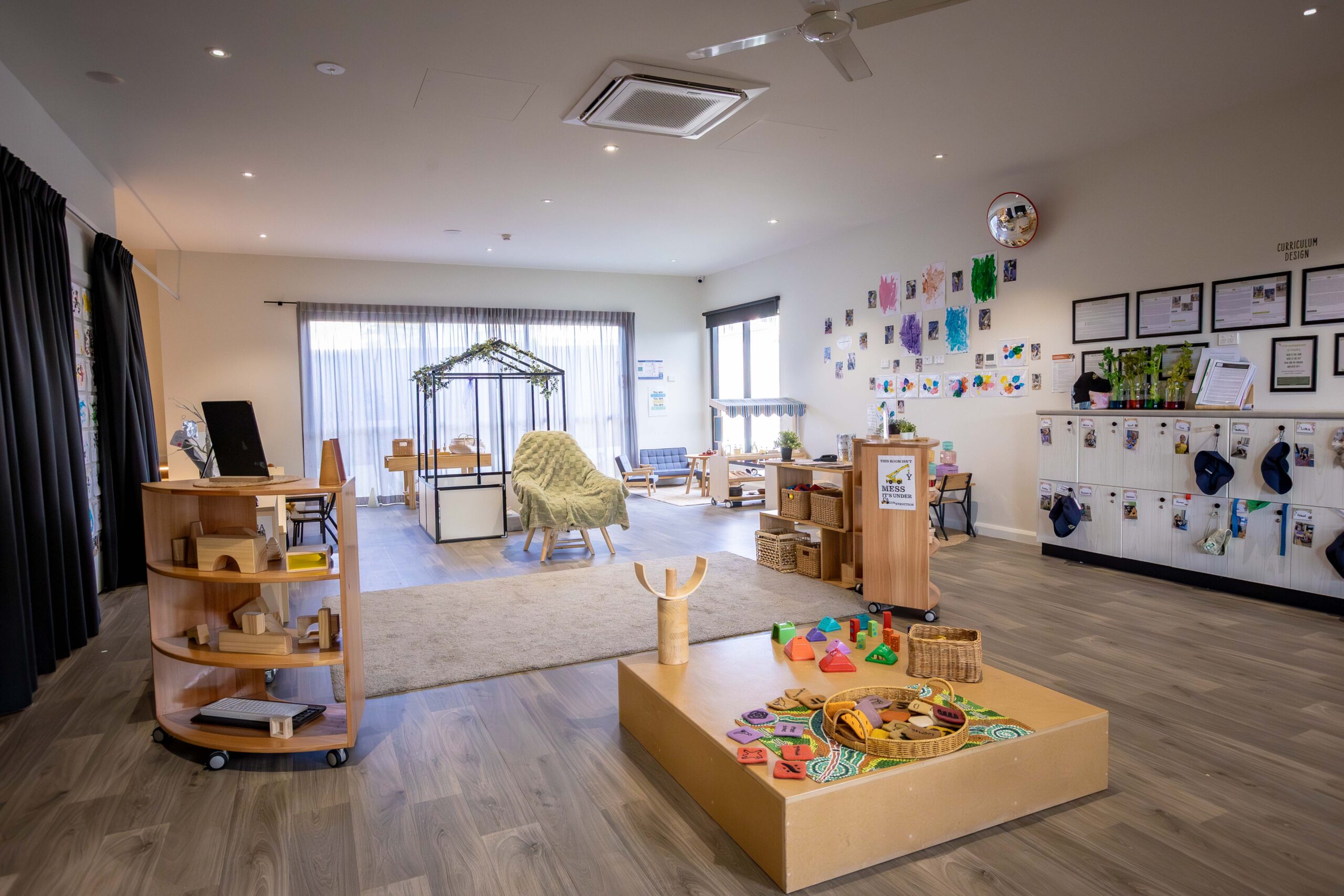
While it’s important to look beyond the physical childcare space, a quality childcare facility should provide purpose-built environments that support learning and wellbeing. Considered learning spaces play a key role in shaping how children interact with, explore, and learn about the world around them. This extends to furniture, objects, and materials, with multi-use tools enabling open-ended play and exploration.
Well-designed spaces encourage independence and exploration, influencing how children play, learn, and interact with the people and spaces around them.
What to look for: Natural light, calm retreat areas, age-appropriate learning zones, nature play opportunities, open-ended materials, and dedicated creative spaces such as an Atelier or art studio.
7. Safety and security you can actually see
For many parents, the health, safety, and wellbeing of their child when in care is a key priority. Safety and security encompass a number of essential systems and practices, including sign-in systems, secure access, active supervision, hygiene and cleanliness procedures.
Although these systems and practices aren’t always obvious when you step into a childcare facility, they’re directly linked to children’s wellbeing. Good childcare centres can strike a balance between safety and the freedom to explore.
What to look for: Secure entry systems, sign-in and sign-out processes, active supervision, hygiene practices, and clean, well-maintained spaces.
8. Quality inclusions and nutritious food
Some childcare providers offer a range of inclusions in their service, including meals from fresh, daily menus, nappies, and wipes. These inclusions also cover how dietary needs and allergies are managed on-site. Ultimately, these inclusions are offered to support children and their families.
Not only do these inclusive services make daily routines easier for families, but good nutrition supports growth, concentration, and effective learning.
A question worth asking: How are allergens and dietary requirements managed at your centre?
9. A clear Kindy and school readiness pathway
Many parents send their little ones to daycare to help them develop the skills needed to support a smooth transition into Prep and formal schooling. Queensland Government-approved childcare centres offer a Free Kindy program for eligible children, helping them develop the foundational skills they need for a strong start to their education. These programs include a personalised Transition Statement that celebrates your child’s progress and achievements and is shared with their new school to support a positive and seamless transition.
School readiness is about social, emotional and learning skills, just as much as academics, and children benefit greatly from a gradual, supported transition.
A question worth asking: How do you help children prepare for the transition to Prep?
10. Strong family communication
Children’s learning outcomes are strongest when their family is involved, and this level of involvement requires a foundation of strong family communication. Many childcare services provide daily updates and learning journals via dedicated apps such as Storypark. Parents and families should feel welcome to touch base with the educators and leave feedback that will be heard and, if necessary, actioned.
Strong, transparent communication helps parents to feel informed and involved in their child’s education and care. Clear communication supports consistency between home life and their childcare centre, which aids children’s development.
A question worth asking: How do you communicate with parents and families throughout the day?
11. Thoughtful support for settling in and big feelings
At this age, children are still learning to navigate and manage their emotions with the help of parents and caregivers. Quality childcare providers should have a clear approach to emotional wellbeing and transitions. Better yet, this approach should be tailored to each individual child to ensure they get the support they need in the moment.
Starting childcare is a major adjustment for many children and parents, but responsive support builds confidence and resilience.
What to look for: Stay-and-play visits, gradual settling-in processes, tailored approaches to separation anxiety, emotional regulation support, and comforting, responsive educator practices.
12. The overall vibe: Trust what you see and feel
As a parent, it’s important to trust your intuition. The atmosphere can’t be captured on the website, but you can often get a good feel for a provider when touring the facility. Happy children are the clearest sign of all, so if they’re engaged, relaxed, and absorbed in play, it’s often a good sign of a quality childcare provider.
Families should feel welcomed and comfortable. If the centre has a positive feel during your visit, it’s likely to be a welcoming, supportive space for your child.
What to look for: Calm, present educators and children absorbed in play.
Finding the best early learning centre for your child
Quality is more than just facilities, awards, and flashy websites. At the end of the day, the best early learning centre is one where your child feels safe, supported, challenged, and genuinely happy.
While you can do a lot of research online, the best way to observe the factors that matter most is on a centre tour. Use this checklist when comparing centres to help you narrow down your options and make a confident decision. After all, once you know what to look for, spotting quality childcare becomes much easier.
Book a tour of your local KIDS ELC to see how we can support your child to blossom.
Frequently asked questions
What does an Exceeding NQS rating mean?
A rating of Exceeding the NQS indicates that a childcare provider is going above and beyond all areas of the National Quality Standard while demonstrating the following three themes:
- Practice is embedded in service operations.
- Practice is informed by critical reflection.
- Practice is shaped by meaningful engagement with families and/or the community.
Childcare providers must undergo an independent assessment to determine their NQS rating.
What should I ask on a childcare tour?
It’s often worth prioritising your questions about topics such as staffing, curriculum, communication, safety, and school readiness. Refer to the checklist above for more specific questions to ask on your tour.
How many childcare centres should I visit before choosing?
Visiting at least three childcare centres can help you get a real feel for each environment, compare how they’re run day-to-day, and make a confident decision without feeling overwhelmed.